
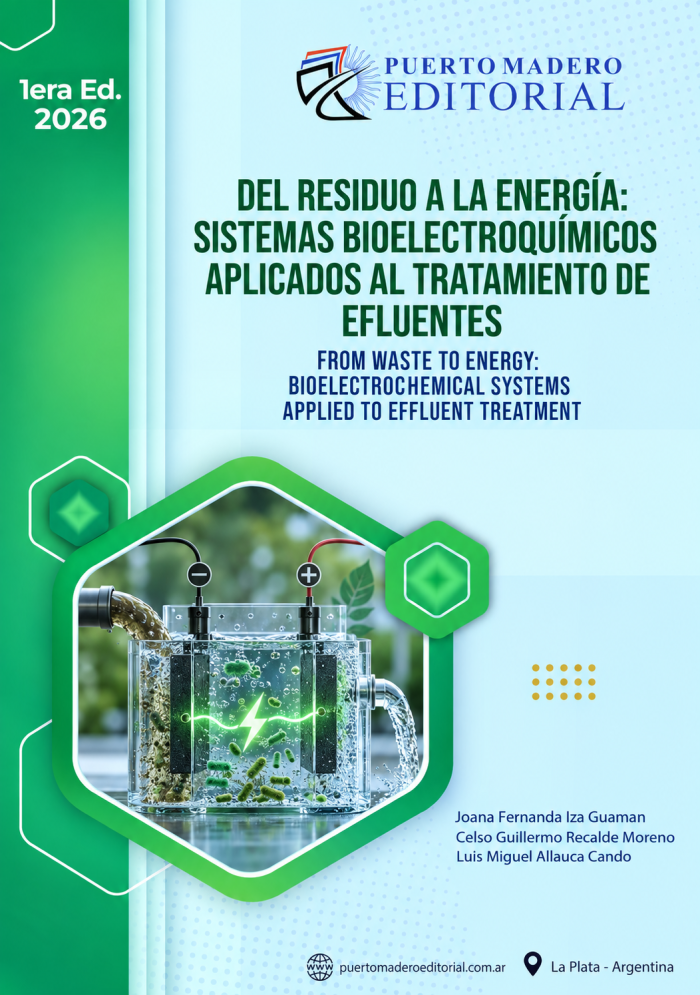
Del residuo a la energía: sistemas bioelectroquímicos aplicados al tratamiento de efluentes
Synopsis
Los sistemas bioelectroquímicos integran la actividad catalítica de comunidades microbianas con procesos electroquímicos de electrodo, y permiten acoplar el tratamiento de efluentes con la recuperación de energía, hidrógeno y materiales de valor. Esta obra sistematiza sus fundamentos, su desarrollo en Sudamérica y su aplicación a la recuperación de metales pesados en efluentes mineros, mediante una revisión de la literatura publicada entre 2015 y 2026 en las bases Scopus, Web of Science y SciELO. El primer capítulo establece los fundamentos electroquímicos y microbiológicos: termodinámica, potenciales redox, curvas de polarización, sobrepotenciales, materiales de electrodo y mecanismos de transferencia extracelular de electrones. El segundo revisa la investigación desarrollada en Ecuador y en el resto del continente, con atención a los sustratos regionales, a los materiales de bajo costo y a las configuraciones ensayadas. El tercero aborda la recuperación y remediación de metales pesados en efluentes de la actividad extractiva, incluidos el cromo, el cobre, el arsénico y el mercurio, así como el tratamiento del drenaje ácido de minas. La revisión evidencia que la investigación sudamericana ha desarrollado una aproximación propia, basada en el aprovechamiento de comunidades microbianas nativas y de residuos agroindustriales locales, y que su valor reside más en la depuración y el sensado ambiental que en la generación de energía, dado que la densidad de potencia a escala piloto permanece entre 0,1 y 10 W·m⁻³. Las principales limitaciones para su despliegue no son solo técnicas: incluyen la ausencia de demostraciones a escala piloto en la región y la debilidad de la transferencia hacia el sector productivo.
Palabras clave: sistemas bioelectroquímicos; celdas de combustible microbianas; tratamiento de efluentes; recuperación de metales pesados; drenaje ácido de minas; biohidrógeno; Sudamérica.
Downloads
Download data is not yet available.
References
Abbas, S. Z., & Rafatullah, M. (2021). Recent advances in soil microbial fuel cells for soil contaminants remediation. Chemosphere, 272, 129691. https://doi.org/10.1016/j.chemosphere.2021.129691
Abd-almohi, H. H., Alismaeel, Z. T., & M-Ridha, M. J. (2025). Inspection the impact of mixing and external resistance on the Microbial Desalination Cell for electricity generation and desalination efficiency by using Macroalgae as a bio-cathode. Journal of the Indian Chemical Society, 102(1), 101543. https://doi.org/10.1016/j.jics.2024.101543
Abdulwahhab, M. A., Najim, S. T., & Abdulwahhab, M. A. (2023). Microbial fuel cell review: thermodynamic and infuencing factors, exoelectrogenic bacteria, anode and cathode configuration. Journal of Chemical Technology & Biotechnology, 98(7), 1559–1583. https://doi.org/10.1002/jctb.7371
Aber, S., Shi, Z., Xing, K., Rameezdeen, R., Chow, C. W. K., Hagare, D., & Jindal, T. (2023). Microbial Desalination Cell for Sustainable Water Treatment: A Critical Review. In Global Challenges (Vol. 7, Number 10). John Wiley and Sons Inc. https://doi.org/10.1002/gch2.202300138
Aboelela, D., & Aly Soliman, M. (2024). Hydrogen production from microbial electrolysis cells powered with microbial fuel cells. Journal of King Saud University - Engineering Sciences, 36(6), 369–374. https://doi.org/10.1016/j.jksues.2022.05.008
Agüero-Quiñones, R., Ávila-Sánchez, Z., Rojas-Flores, S., Cabanillas-Chirinos, L., Cruz-Noriega, M. D. La, Cruz-Monzón, J., & Nazario-Naveda, R. (2023). Cadmium and COD Removal from Municipal Wastewater Using Chlorella sp. Biomass in Microbial Fuel Cells. Sustainability (Switzerland), 15(19). https://doi.org/10.3390/su151914513
Ahirwar, A., Das, S., Das, S., Yang, Y.-H., Bhatia, S. K., Vinayak, V., & Ghangrekar, M. M. (2023). Photosynthetic microbial fuel cell for bioenergy and valuable production: A review of circular bio-economy approach. Algal Research, 70, 102973. https://doi.org/10.1016/j.algal.2023.102973
Ai, C., Yan, Z., Hou, S., Zheng, X., Zeng, Z., Amanze, C., Dai, Z., Chai, L., Qiu, G., & Zeng, W. (2020). Effective treatment of acid mine drainage with microbial fuel cells: An emphasis on typical energy substrates. Minerals, 10(5). https://doi.org/10.3390/min10050443
Al-Asheh, S., Bagheri, M., & Aidan, A. (2022). Removal of heavy metals from industrial wastewater using microbial fuel cell. Engineering in Life Sciences, 22(8), 535–549. https://doi.org/10.1002/elsc.202200009
Almeida-Guerra, P., Pindo, J., Hernandez, M., & Coronel, J. (2023). Application of Sustainable Remediation Techniques for Heavy Metal Reduction in Polluted Rivers in Mining Zones: Study Area Ponce Enriquez. ESPOCH Congresses: The Ecuadorian Journal of S.T.E.A.M., 3(1), 248–268. https://doi.org/10.18502/espoch.v3i1.14450
Alvarez, A. J., Fuentes, K. L., Alberto Arias, C., & Chaparro, T. (2022). Production of hydrogen from beverage wastewater by dark fermentation in an internal circulation reactor: Effect on pH and hydraulic retention time. Energy Conversion and Management: X, 15(2). https://doi.org/10.1016/j.ecmx.2022.100232
Amen, M. T., Yasin, A. S., Hegazy, M. I., Jamal, M. A. H. M., Hong, S. T., & Barakat, N. A. (2021). Rainwater driven microbial fuel cells for power generation in remote areas. Royal Society Open Science, 8(11). https://doi.org/10.1098/rsos.210996
Amirdehi, M. A., Gong, L., Khodaparastasgarabad, N., Sonawane, J. M., Logan, B. E., & Greener, J. (2022). Hydrodynamic interventions and measurement protocols to quantify and mitigate power overshoot in microbial fuel cells using microfluidics. Electrochimica Acta, 405, 139771. https://doi.org/10.1016/j.electacta.2021.139771
Angelov, A., Bratkova, S., Ivanov, R., & Velichkova, P. (2023). Treatment of Acid Mine Drainage in a Bioelectrochemical System, Based on an Anodic Microbial Sulfate Reduction. Journal of Ecological Engineering, 24(7), 175–186. https://doi.org/10.12911/22998993/164755
Apollon, W. (2023). An Overview of Microbial Fuel Cell Technology for Sustainable Electricity Production. In Membranes (Vol. 13, Number 11). Multidisciplinary Digital Publishing Institute (MDPI). https://doi.org/10.3390/membranes13110884
Arboleda, D. G., Núñez, O. F., Sánchez, O. F., Chinchin, B. D., Arboleda, D. A., & Bahamonde, R. A. (2019). Application of a direct current circuit to pick up and to store bioelectricity produced by microbial fuel cells. Revista Colombiana de Quimica, 48(3), 26–35. https://doi.org/10.15446/rev.colomb.quim.v48n3.77011
Arruda, C., Tadeu, L., & Americo, L. (2020). Thermophilic biohydrogen production from sugarcane molasses under low pH: Metabolic and microbial aspects. International Journal of Hydrogen Energy, 45(xxxx), 1–11. https://doi.org/10.1016/j.ijhydene.2019.12.013
Ashwaniy, V. R. V., & Perumalsamy, M. (2017). Reduction of organic compounds in petro-chemical industry effluent and desalination using Scenedesmus abundans algal microbial desalination cell. Journal of Environmental Chemical Engineering, 5(6), 5961–5967. https://doi.org/10.1016/j.jece.2017.11.017
Babanova, S., Jones, J., Phadke, S., Lu, M., Angulo, C., Garcia, J., Carpenter, K., Cortese, R., Chen, S., Phan, T., & Bretschger, O. (2020). Continuous flow, large-scale, microbial fuel cell system for the sustained treatment of swine waste. Water Environment Research, 92(1), 60–72. https://doi.org/10.1002/wer.1183
Barahoei, M., Hatamipour, M. S., Khosravi, M., Afsharzadeh, S., & Feghhipour, S. E. (2021). Salinity reduction of brackish water using a chemical photosynthesis desalination cell. Science of The Total Environment, 779, 146473. https://doi.org/10.1016/j.scitotenv.2021.146473
Barbato, R. A., Jones, R. M., Musty, M. A., & Slone, S. M. (2021). Reading the ground: understanding the response of bioelectric microbes to anthropogenic compounds in soil based terrestrial microbial fuel cells. PLoS ONE, 16(12), e0260528. https://doi.org/10.1371/journal.pone.0260528
Bayoumi, M., Hassouna, M. S., Hussien, A. A., & Moustafa, H. M. A. (2026). Waste to energy through sustainable bioenergy and biohydrogen production from lignocellulosic waste using microbial fuel cell and microbial electrolysis cell. Scientific Reports, 16(1). https://doi.org/10.1038/s41598-026-50075-3
Blanco-Cocom, L., Botello-Rionda, S., Ordoñez, L. C., & Valdez, S. I. (2023). Design optimization and parameter estimation of a PEMFC using nature-inspired algorithms. Soft Computing, 27(7), 3765–3784. https://doi.org/10.1007/s00500-022-07520-y
Borja-Maldonado, F., & López Zavala, M. Á. (2022). Contribution of configurations, electrode and membrane materials, electron transfer mechanisms, and cost of components on the current and future development of microbial fuel cells. Heliyon, 8(7). https://doi.org/10.1016/j.heliyon.2022.e09849
Buitrón, G., Muñoz-Páez, K. M., Quijano, G., Carrillo-Reyes, J., & Albarrán-Contreras, B. (2020). Biohydrogen production from winery effluents: control of the homoacetogenesis through the headspace gas recirculation. Journal of Chemical Technology and Biotechnology, 95(3), 544–552. https://doi.org/10.1002/jctb.6263
Cao, Y., Mu, H., Liu, W., Zhang, R., Guo, J., Xian, M., & Liu, H. (2019). Electricigens in the anode of microbial fuel cells: Pure cultures versus mixed communities. In Microbial Cell Factories (Vol. 18, Number 1). BioMed Central Ltd. https://doi.org/10.1186/s12934-019-1087-z
Cardenas, D., Villegas, J., Solis, C., Uribe, L., & Fuentes, P. (2022). Evaluación del desempeño de una celda de combustible microbiana con electrodo de grafito modificado para el tratamiento de agua residual del procesamiento del café. Revista Colombiana de Química, 51(1). https://www.redalyc.org/journal/3090/309072509005/309072509005.pdf
Catania, C., Karbelkar, A. A., & Furst, A. L. (n.d.). Engineering the interface between electroactive bacteria and electrodes.
Cesar Minga, J., Elorza, F. J., Rodriguez, R., Iglesias, A., & Esenarro, D. (2023). Assessment of Water Resources Pollution Associated with Mining Activities in the Parac Subbasin of the Rimac River. Water (Switzerland), 15(5). https://doi.org/10.3390/w15050965
Chakma, R., Hossain, M. K., Paramasivam, P., Bousbih, R., Amami, M., Toki, G. F. I., Haldhar, R., & Karmaker, A. K. (2025). Recent Applications, Challenges, and Future Prospects of Microbial Fuel Cells: A Review. In Global Challenges (Vol. 9, Number 5). John Wiley and Sons Inc. https://doi.org/10.1002/gch2.202500004
Chandrasekhar, K., Kumar, A. N., Raj, T., Kumar, G., & Kim, S. (2021). Bioelectrochemical system-mediated waste valorization. Systems Microbiology and Biomanufacturing, 1(4), 432–443. https://doi.org/10.1007/s43393-021-00039-7
Cieciura, W., & Borowski, S. (2020). Biohydrogen production from fruit and vegetable waste, sugar beet pulp and corn silage via dark fermentation. Renewable Energy, 153: 1226–1237. https://doi.org/10.1016/j.renene.2020.02.085
Clarke, T. A. (2022). Plugging into bacterial nanowires: a comparison of model electrogenic organisms. Current Opinion in Microbiology, 66, 56–62. https://doi.org/10.1016/j.mib.2021.12.003
Dange, P., Pandit, S., Jadhav, D., Shanmugam, P., Gupta, P. K., Kumar, S., Kumar, M., Yang, Y. H., & Bhatia, S. K. (2021). Recent developments in microbial electrolysis cell-based biohydrogen production utilizing wastewater as a feedstock. Sustainability (Switzerland), 13(16). https://doi.org/10.3390/su13168796
Das, S. R., & Basak, N. (2021). Molecular biohydrogen production by dark and photo fermentation from wastes containing starch: recent advancement and future perspective. In Bioprocess and Biosystems Engineering (Vol. 44, Number 1). Springer Science and Business Media Deutschland GmbH. https://doi.org/10.1007/s00449-020-02422-5
Das, S., Raj, R., Das, S., & Ghangrekar, M. (2021). A Sustainable Approach for the Production of Green Energy With the Holistic Treatment of Wastewater Through Microbial Electrochemical Technologies: A Review. Frontiers in Sustainability, 2(12): 1–18, 2(12), 1–18. https://doi.org/10.3389/frsus.2021.792028
Do, M. H., Ngo, H. H., Guo, W., Chang, S. W., Nguyen, D. D., Pandey, A., Sharma, P., Varjani, S., Nguyen, T. A. H., & Hoang, N. B. (2022). A dual chamber microbial fuel cell based biosensor for monitoring copper and arsenic in municipal wastewater. Science of The Total Environment, 811, 152261. https://doi.org/10.1016/j.scitotenv.2021.152261
Dong, H., Yu, H., Wang, X., & Zhou, Q. (2012). Carbon-supported perovskite oxides as oxygen reduction reaction catalyst in single chambered microbial fuel cells. Wiley Online Library. https://doi.org/10.1002/jctb.3893
Dong, Y., Gao, Z., Di, J., Wang, D., Yang, Z., Guo, X., & Zhu, X. (2024). Study on the effectiveness of sulfate-reducing bacteria to remove Pb(II) and Zn(II) in tailings and acid mine drainage. Frontiers in Microbiology, 15. https://doi.org/10.3389/fmicb.2024.1352430
Dzulkarnain, E. L. N., Audu, J. O., Wan Dagang, W. R. Z., & Abdul-Wahab, M. (2022). Microbiomes of biohydrogen production from dark fermentation of industrial wastes: current trends, advanced tools and future outlook. Bioresources and Bioprocessing, 9(1), 9(1). https://doi.org/10.1186/s40643-022-00504-8
Ebaid, R., Henjes, J., Hanelt, D., & Ende, S. (2025). Spontaneous sequential desalination as a promising strategy for biological salt removal and production of value-added compounds from microalgae. Journal of Water Process Engineering, 78. https://doi.org/10.1016/j.jwpe.2025.108758
Enrique, Á. (2020). Estado Geopolítica de las tierras raras : un recurso natural estratégico para la seguridad multidimensional del Estado. Revista Científica General José María Córdova. https://doi.org/http://dx.doi.org/10.21830/19006586.587
Ewusi-Mensah, D., Huang, J., Chaparro, L. K., Rodenas, P., Ramírez-Moreno, M., Ortiz, J. M., & Esteve-Núñez, A. (2021). Algae-assisted microbial desalination cell: Analysis of cathode performance and desalination efficiency assessment. Processes, 9(11). https://doi.org/10.3390/pr9112011
Fadzli, F. S., Bhawani, S. A., & Adam Mohammad, R. E. (2021). Microbial Fuel Cell: Recent Developments in Organic Substrate Use and Bacterial Electrode Interaction. In Journal of Chemistry (Vol. 2021). Hindawi Limited. https://doi.org/10.1155/2021/4570388
Fang, C., & Achal, V. (2019). The potential of microbial fuel cells for remediation of heavy metals from soil and water—review of application. In Microorganisms (Vol. 7, Number 12). MDPI AG. https://doi.org/10.3390/microorganisms7120697
Fathima, A., Ilankoon, I. M. S. K., & Chong, M. N. (2024). Improving Scalability of copper recovery in saline microbial fuel cells with microtubular polypyrrole-based cathodic electrocatalysts. Chemosphere, 363. https://doi.org/10.1016/j.chemosphere.2024.142800
Fatima, M., Kiros, Y., & Farooq, R. (2021). Low-Cost Single Chamber MFC Integrated with Novel Lignin-Based Carbon Fiber Felt Bioanode for Treatment of Recalcitrant Azo Dye. Frontiers in Energy Research, 9(6): 1–13, 9(6), 1–13. https://doi.org/10.3389/fenrg.2021.672817
Fernando, E., & Keshavarz, T. (2019). The use of bioelectrochemical systems in environmental remediation of xenobiotics: a review. Journal of Chemical Technology and Biotechnology, 94(7), 2070–2080. https://doi.org/10.1002/jctb.5848
Flores, M., Vázquez, V. Á., Medellín, A., Álvarez, C. C., Benavides, A. C., Pérez, O., Judith, G., & Delgado, L. (2021). Ibuprofen degradation and energy generation in a microbial fuel cell using a bioanode fabricated from devil fish bone char. Journal of Environmental Science and Health, 56(8), 874–885. https://doi.org/10.1080/10934529.2021.1934357
Garbinski, L. D., Rosen, B. P., & Chen, J. (2019). Pathways of arsenic uptake and efflux. In Environment International (Vol. 126, pp. 585–597). Elsevier Ltd. https://doi.org/10.1016/j.envint.2019.02.058
García, V. J., Márquez, C. O., Cedeño, A. R., & Montesdeoca, K. G. (2019). Assessing bioremediation of soils polluted with fuel oil 6 by means of diffuse reflectance spectroscopy. Resources, 8(1), 1–14. https://doi.org/10.3390/resources8010036
Gaurav, K., Singh, R., & Tiwari, B. K. (2019). Novel proton exchange membranes based on PVC for microbial fuel cells (MFCs). Journal of Polymer Engineering, 39(4), 360–367. https://doi.org/10.1515/polyeng-2018-0276
Gbiete, D., Narra, S., Mani Kongnine, D., Narra, M. M., & Nelles, M. (2024). Insights into Biohydrogen Production Through Dark Fermentation of Food Waste: Substrate Properties, Inocula, and Pretreatment Strategies. In Energies (Vol. 17, Number 24). Multidisciplinary Digital Publishing Institute (MDPI). https://doi.org/10.3390/en17246350
González, J. R., Del Carmen Monterrubio-Badillo, M., Ordaz, A., & Garciá, E. I. (2022). Influence of Fe2+and Fe3+on the Performance and Microbial Community Composition of a MFC Inoculated with Sulfate-Reducing Sludge and Acetate as Electron Donor. Journal of Chemistry. https://doi.org/10.1155/2022/5685178
Goto, Y., Yoshida, N., Umeyama, Y., Yamada, T., & Tero, R. (2015). Enhancement of electricity production by graphene oxide in soil microbial fuel cells and plant microbial fuel cells. Frontiers in Bioengineering and Biotechnology, 3(4), 1–8. https://doi.org/10.3389/fbioe.2015.00042
Guan, Y., Liu, R., Zhou, Y., Zhu, H., Tong, S., Wang, Y., Wei, K., & Han, W. (2026). Multifunctional microbial desalination cell for industrial wastewater treatment: Synergistic pyridine degradation, nitrogen removal and desalination. Journal of Environmental Chemical Engineering, 14(2), 122046. https://doi.org/10.1016/j.jece.2026.122046
Gujjala, L. K. S., Dutta, D., Sharma, P., Kundu, D., Vo, D.-V. N., & Kumar, S. (2022). A state-of-the-art review on microbial desalination cells. Chemosphere, 288, 132386. https://doi.org/10.1016/j.chemosphere.2021.132386
Gul, H., Raza, W., Lee, J., Azam, M., Ashraf, M., & Kim, K.-H. (2021). Progress in microbial fuel cell technology for wastewater treatment and energy harvesting. Chemosphere, 281, 130828. https://doi.org/10.1016/j.chemosphere.2021.130828
Guo, Y., Cao, D., Tang, S., Hu, Y., Dong, W., & Wu, X. (2025). Efficient Chromium(VI) Removal Through In Situ Nano-Iron Sulfide Formation at the Cathode of Microbial Fuel Cells. Water (Switzerland), 17(14). https://doi.org/10.3390/w17142073
Harani, B. K., Quershi, K., Shaikh, M. S., Jatoi, A. S., & Mubarak, N. M. (2026). Electron Transfer Mechanisms in Bio-Electrochemical Systems (pp. 101–116). https://doi.org/10.1007/978-981-95-4310-6_7
Hazzan, O. O., Zhao, B., & Xiao, Y. (2023). Strategies for Enhancing Extracellular Electron Transfer in Environmental Biotechnology: A Review. In Applied Sciences (Switzerland) (Vol. 13, Number 23). Multidisciplinary Digital Publishing Institute (MDPI). https://doi.org/10.3390/app132312760
He, L., Du, P., Chen, Y., Lu, H., Cheng, X., & Chang, B. (2017). Advances in microbial fuel cells for wastewater treatment. Renewable and Sustainable Energy Reviews. https://doi.org/10.1016/j.rser.2016.12.069
Holmes, D. E., Nicoll, J. S., Bond, D. R., & Lovley, D. R. (2004). Potential role of a novel psychrotolerant member of the family Geobacteraceae, Geopsychrobacter electrodiphilus gen. nov., sp. nov., in electricity production by a marine sediment fuel cell. Applied and Environmental Microbiology, 70(10), 6023–6030. https://doi.org/10.1128/AEM.70.10.6023-6030.2004
Horváth-Gönczi, N. N., Bagi, Z., Szuhaj, M., Rákhely, G., & Kovács, K. L. (2023). Bioelectrochemical Systems (BES) for Biomethane Production—Review. In Fermentation (Vol. 9, Number 7). Multidisciplinary Digital Publishing Institute (MDPI). https://doi.org/10.3390/fermentation9070610
Huaynate, A. O., Gallegos, M. C., Ramos, L. F., & Soto, A. R. (2021). Potential assessment of Desmodesmus asymmetricus and Chlorella vulgaris for removal of nitrates and phosphates in wastewater. Revista Peruana de Biologia, 28(1). https://doi.org/10.15381/RPB.V28I1.18082
Hubenova, Y., Chorbadzhiyska, E., Kostov, K. L., & Mitov, M. (2023). Efficient gold recovery by microbial electrochemical technologies. Bioelectrochemistry, 149. https://doi.org/10.1016/j.bioelechem.2022.108311
Hynninen, A., Touzé, T., Pitkänen, L., Mengin-Lecreulx, D., & Virta, M. (2009). An efflux transporter PbrA and a phosphatase PbrB cooperate in a lead-resistance mechanism in bacteria. Molecular Microbiology, 74(2), 384–394. https://doi.org/10.1111/j.1365-2958.2009.06868.x
Hyun, J., Jo, W., Yang, S. H., Shin, S.-H., Doo, G., Choi, S., Lee, D.-H., Lee, D. W., Oh, E., Lee, J. Y., & Kim, H.-T. (2022). Tuning of water distribution in the membrane electrode assembly of anion exchange membrane fuel cells using functionalized carbon additives. Journal of Power Sources, 543, 231835. https://doi.org/10.1016/j.jpowsour.2022.231835
Imoro, A. Z., Mensah, M., & Buamah, R. (2021). Developments in the microbial desalination cell technology: A review. In Water-Energy Nexus (Vol. 4, pp. 76–87). KeAi Communications Co. https://doi.org/10.1016/j.wen.2021.04.002
Iza, J., Cuadrado, J., García, L., Recalde, C., Nurmi, P., Zuniga, A., & Maldonado, V. (2026). Operando Failure Diagnosis and Performance Dynamics in Microbial Fuel Cells Treating Mine Waste. https://doi.org/10.64898/2026.09.02.748966
Iza, J., Recalde Moreno, C. G., & Iza, C. F. (2022). DETERMINANTES GENÉTICOS Y SUS MECANISMOS DE ACCIÓN IMPLICADOS EN LA RESISTENCIA BACTERIANA A METALES PESADOS: UNA REVISIÓN. Perfiles, 1(27), 26–38. https://doi.org/10.47187/perf.v1i27.147
Jadhav, D. A., Park, S.-G., Pandit, S., Yang, E., Ali Abdelkareem, M., Jang, J.-K., & Chae, K.-J. (2022). Scalability of microbial electrochemical technologies: Applications and challenges. Bioresource Technology, 345, 126498. https://doi.org/10.1016/j.biortech.2021.126498
Jaiswal, K. K., Kumar, V., Vlaskin, M. S., Sharma, N., Rautela, I., Nanda, M., Arora, N., Singh, A., & Chauhan, P. K. (2020). Microalgae fuel cell for wastewater treatment: Recent advances and challenges. Journal of Water Process Engineering, 38, 101549. https://doi.org/10.1016/j.jwpe.2020.101549
Jalili, P., Ala, A., Nazari, P., Jalili, B., & Ganji, D. D. (2024). A comprehensive review of microbial fuel cells considering materials, methods, structures, and microorganisms. In Heliyon (Vol. 10, Number 3). Elsevier Ltd. https://doi.org/10.1016/j.heliyon.2024.e25439
Jatoi, A. S., Hashmi, Z., Mazari, S. A., Mubarak, N. M., Karri, R. R., Ramesh, S., & Rezakazemi, M. (2022). A comprehensive review of microbial desalination cells for present and future challenges. Desalination, 535, 115808. https://doi.org/10.1016/j.desal.2022.115808
Jia, H., Li, G., Liu, X., Ma, X., Li, L., & Han, X. (2025). Performance of microbial desalination cells with different cathode types in treating saline wastewater. Scientific Reports, 15(1), 1–13. https://doi.org/10.1038/S41598-025-01295-6;SUBJMETA=169,172,4081,704,896;KWRD=ENVIRONMENTAL+IMPACT,POLLUTION+REMEDIATION
Jiang, Z., Liu, M., Chen, Y., Qian, X., Dai, Q., Yao, J., & Chen, J. (2025). Extracellular Electron Transfer in Bioelectrochemical System and Its Role in Denitrification: Mechanisms, Enhancement Strategies, and Application Prospects. Bioresource Technology, 437, 133188. https://doi.org/10.1016/j.biortech.2025.133188
Juma Al Balushi, N., Nayak, J. K., Rahman, S., Sana, A., & Al-Mamun, A. (2022). A Comprehensive Study on Air-Cathode Limitations and Its Mitigation Strategies in Microbial Desalination Cell—A Review. In Energies (Vol. 15, Number 20, p. 15). MDPI. https://doi.org/10.3390/en15207459
Kant, S., Palai, A. K., Kumar, A., Kant, R., Kumar, A., & Kumar, V. (2021). Bioresource Technology Trends in renewable energy production employing biomass-based biochar. Bioresource Technology, 340(7). https://doi.org/10.1016/j.biortech.2021.125644
Katuri, K. P., Ali, M., & Saikaly, P. (2019). The role of microbial electrolysis cell in urban wastewater treatment: integration options, challenges, and prospects. Current Opinion in Biotechnology, 57(120L), 101–110. https://doi.org/10.1016/j.copbio.2019.03.007
Knoll, M. T., Jürgensen, N., Weiler, J. R., & Gescher, J. (2023). Predictability and robustness of anode biofilm to changing potential in microbial electrolysis system. Bioresource Technology Reports, 24. https://doi.org/10.1016/j.biteb.2023.101640
Koffi, N. J., & Okabe, S. (2020). Domestic wastewater treatment and energy harvesting by serpentine up-flow MFCs equipped with PVDF-based activated carbon air-cathodes and a low voltage booster. Chemical Engineering Journal, 380, 122443. https://doi.org/10.1016/j.cej.2019.122443
Koók, L., Nemestóthy, N., Bélafi-Bakó, K., & Bakonyi, P. (2021). The influential role of external electrical load in microbial fuel cells and related improvement strategies: A review. In Bioelectrochemistry (Vol. 140). Elsevier B.V. https://doi.org/10.1016/j.bioelechem.2021.107749
Koul, Y., Devda, V., Varjani, S., & Guo, W. (2022). Microbial electrolysis: a promising approach for treatment and resource recovery from industrial wastewater. Bioengineered, 13(4), 8115–8134. https://doi.org/10.1080/21655979.2022.2051842
Kumar, K., Ding, L., Zhao, H., & Cheng, M. H. (2023). Waste-to-Energy Pipeline through Consolidated Fermentation–Microbial Fuel Cell (MFC) System. In Processes (Vol. 11, Number 8). Multidisciplinary Digital Publishing Institute (MDPI). https://doi.org/10.3390/pr11082451
Kwarteng, F., Huang, J., & Opoku, P. A. (2026). Hexagonally structured microbial desalination cell for bio-electrochemically mediated removal of pollutants and improved desalination of hypersaline solution. Bioelectrochemistry, 168, 109118. https://doi.org/10.1016/j.bioelechem.2025.109118
Lacerda, L. D., & Salomons, W. (1999). Mercury Contamination from New World Gold and Silver Mine Tailings. In Mercury Contaminated Sites (pp. 73–87). https://link.springer.com/chapter/10.1007/978-3-662-03754-6_3
León, E., & Zapata, A. D. (2018). Hydrogen Production from Coffee Mucilage in Dark. Energies. https://doi.org/10.3390/en12010071
Li, S., Ho, S., Hua, T., Zhou, Q., & Li, F. (2020). Sustainable biochar as electrocatalysts for the oxygen reduction reaction in microbial fuel cells. Green Energy and Environment. https://doi.org/10.1016/j.gee.2020.11.010
Liang, P., Duan, R., Jiang, Y., Zhang, X., Qiu, Y., & Huang, X. (2018). One-year operation of 1000-L modularized microbial fuel cell for municipal wastewater treatment. Water Research, 141, 1–8. https://doi.org/10.1016/j.watres.2018.04.066
Liu, F., Ma, B., He, Z., & Bai, P. (2022). Electron transfer kinetics at anode interface in microbial electrochemical systems. Electrochimica Acta, 432, 141188. https://doi.org/10.1016/j.electacta.2022.141188
Liu, S., Wang, M., Deng, Y., Feng, X., & Pyo, S. H. (2025). Individual and competitive removal of Cr(VI) and Cu(II) by microbial fuel cell constructed wetlands. Journal of Environmental Chemical Engineering, 13(2). https://doi.org/10.1016/j.jece.2025.115917
Liu, Z., Xiang, P., Duan, Z., Fu, Z., Zhang, L., & Zhang, Z. (2019). Electricity generation, salinity, COD removal and anodic biofilm microbial community vary with different anode CODs in a microbial desalination cell for high-salinity mustard tuber wastewater treatment. RSC Advances, 9(43), 25189–25198. https://doi.org/10.1039/c9ra04184b
Logroño, W., Echeverría, M., Recalde, C., & Graziani, P. (2015). Bioconversión de residuos sólidos orgánicos con suelos de la región Amazónica y alto andina del Ecuador en celdas de combustible microbiano de cámara simple. Informacion Tecnologica, 26(2), 61–68. https://doi.org/10.4067/S0718-07642015000200008
Logroño, W., Guambo, A., Pérez, M., Kadier, A., & Recalde, C. (2016). A terrestrial single chamber microbial fuel cell-based biosensor for biochemical oxygen demand of synthetic ricewashed wastewater. Sensors (Switzerland), 16(1). https://doi.org/10.3390/s16010101
Logroño, W., Kadier, A., Bakonyi, P., Nemestóthy, N., Bélafi-Bakó, K., Echeverria, M., Recalde, C., & Rakhely, G. (2017). A novel miniaturized terrestrial microbial fuel cell reveals rapid electrochemical signals. Energy Procedia, 142, 1482–1487. https://doi.org/10.1016/j.egypro.2017.12.596
Logroño, W., Pérez, M., Urquizo, G., Kadier, A., Echeverría, M., Recalde, C., & Rákhely, G. (2017). Single chamber microbial fuel cell (SCMFC) with a cathodic microalgal biofilm: A preliminary assessment of the generation of bioelectricity and biodegradation of real dye textile wastewater. Chemosphere, 176, 378–388. https://doi.org/10.1016/j.chemosphere.2017.02.099
Logroño, W., Ramírez, G., Recalde, C., Echeverría, M., & Cunachi, A. (2015). Bioelectricity generation from vegetables and fruits wastes by using single chamber microbial fuel cells with high Andean soils. Energy Procedia, 75, 2009–2014. https://www.sciencedirect.com/science/article/pii/S1876610215010279
López Zavala, M. Á., & Cámara Gutiérrez, I. C. (2023). Effects of External Resistance, New Electrode Material, and Catholyte Type on the Energy Generation and Performance of Dual-Chamber Microbial Fuel Cells. Fermentation, 9(4). https://doi.org/10.3390/fermentation9040344
Madondo, N. I., Rathilal, S., Bakare, B. F., & Tetteh, E. K. (2023). Application of Bioelectrochemical Systems and Anaerobic Additives in Wastewater Treatment: A Conceptual Review. In International Journal of Molecular Sciences (Vol. 24, Number 5). Multidisciplinary Digital Publishing Institute (MDPI). https://doi.org/10.3390/ijms24054753
Mafane, D., Ngulube, T., & Mphahlele-Makgwane, M. M. (2025). Anaerobic Bioremediation of Acid Mine Drainage Using Sulphate-Reducing Bacteria: Current Status, Challenges, and Future Directions. In Sustainability (Switzerland) (Vol. 17, Number 8). Multidisciplinary Digital Publishing Institute (MDPI). https://doi.org/10.3390/su17083567
Magalhães, A. I., Carvalho, J. C., Melo Pereira, G. V., Karp, S. G., Câmara, M. C., Medina, J. D. C., & Soccol, C. R. (2019). Lignocellulosic biomass from agro-industrial residues in South America: current developments and perspectives. In Biofuels, Bioproducts and Biorefining (Vol. 13, Number 6, pp. 1505–1519). John Wiley and Sons Ltd. https://doi.org/10.1002/bbb.2048
Magotra, V. K., Kumar, S., Kang, T. W., Inamdar, A. I., Aqueel, A. T., Im, H., Ghodake, G., Shinde, S., Waghmode, D. P., & Jeon, H. C. (2020). Compost Soil Microbial Fuel Cell to Generate Power using Urea as Fuel. Scientific Reports, 10(1). https://doi.org/10.1038/s41598-020-61038-7
Magotra, V. K., Lee, D.-J., Kim, D. Y., Lee, S. J., Kang, T. W., Magotra, A., Inamdar, A. I., Shrestha, N. K., Patil, S. A., Thammanu, S., & Jeon, H. C. (2023). Increasing power generation to a single-chamber compost soil urea fuel cell for carbon-neutral bioelectricity generation: a novel approach. Frontiers in Microbiology, 14, 1086962. https://doi.org/10.3389/fmicb.2023.1086962
Magrini, F. E., Almeida, G. M., Soares, M., Fuentes, L., Ecthebehere, C., Beal, L. L., & Moura, M. (2020). Effect of different heat treatments of inoculum on the production of hydrogen and volatile fatty acids by dark fermentation of sugarcane vinasse. Biomass Conversion and Biorefinery, 11, 2443–2456. https://doi.org/10.1007/s13399-020-00687-0
Mahata, C., & Ray, S. (2020). Optimization of dark fermentative hydrogen production from organic wastes using acidogenic mixed consortia. Energy Conversion and Management, 219(5). https://doi.org/10.1016/j.enconman.2020.113047
Mahto, K. U., & Das, S. (2025). Electroactive biofilm communities in microbial fuel cells for the synergistic treatment of wastewater and bioelectricity generation. In Critical Reviews in Biotechnology (Vol. 45, Number 2, pp. 434–453). Taylor and Francis Ltd. https://doi.org/10.1080/07388551.2024.2372070
Mamani, L., Berlanda, P., & Roque, F. (2020). Vicia faba Crop Residues for Sustainable Electricity Generation Using a Sludge-based Microbial Fuel Cell. Chemical and Biochemical Engineering Quarterly, 34(4), 289–296. https://doi.org/10.15255/CABEQ.2020.1857
Marassi, R. J., Hermanny, R. S., Silva, G. C., Silva, F. T., & Paiva, T. C. B. (2019). Electricity production and treatment of high-strength dairy wastewater in a microbial fuel cell using acclimated electrogenic consortium. International Journal of Environmental Science and Technology, 16(11), 7339–7348. https://doi.org/10.1007/s13762-019-02391-7
Marin, T., Seccatore, J., De Tomi, G., & Veiga, M. (2016). Economic feasibility of responsible small-scale gold mining. Journal of Cleaner Production, 129, 531–536. https://doi.org/10.1016/j.jclepro.2016.03.161
Marshall, B. G., Veiga, M. M., da Silva, H. A. M., & Guimarães, J. R. D. (2020). Cyanide Contamination of the Puyango-Tumbes River Caused by Artisanal Gold Mining in Portovelo-Zaruma, Ecuador. In Current Environmental Health Reports (Vol. 7, Number 3, pp. 303–310). Springer. https://doi.org/10.1007/s40572-020-00276-3
Martinez-burgos, W. J., Bittencourt, E., Rodrigues, D., Paula, D., Bianchi, A., Medeiros, P., Cesar, J., Carvalho, D., Thomaz, V., Porto, L., Vandenberghe, D. S., & Lorenci, A. (2020). Bioresource Technology Biohydrogen production in cassava processing wastewater using microbial consortia: Process optimization and kinetic analysis of the microbial community. Bioresource Technology, 309(4). https://doi.org/10.1016/j.biortech.2020.123331
MATTE, M. del ambiente, agua y transición ecológica. (2020). NATIONAL ACTION PLAN on the use of Mercury in Artisanal and Small Scale Gold Mining in Ecuador, in accordance with the Minamata Convention on Mercury.
Meng, C., & Dai, S. (2025). Microbial Fuel Cells for Heavy Metal Wastewater Treatment: Mechanisms, Applications, and Challenges. In Highlights in Science, Engineering and Technology ESETEP (Vol. 2025).
Mestanza-Ramón, C., Cuenca-Cumbicus, J., D’orio, G., Flores-Toala, J., Segovia-Cáceres, S., Bonilla-Bonilla, A., & Straface, S. (2022). Gold Mining in the Amazon Region of Ecuador: History and a Review of Its Socio-Environmental Impacts. Land, 11(2). https://doi.org/10.3390/land11020221
Mestanza-Ramón, C., Ordoñez-Alcivar, R., Arguello-Guadalupe, C., Carrera-Silva, K., D’orio, G., & Straface, S. (2022). History, Socioeconomic Problems and Environmental Impacts of Gold Mining in the Andean Region of Ecuador. International Journal of Environmental Research and Public Health, 19(3). https://doi.org/10.3390/ijerph19031190
Mishra, A., & Chhabra, M. (2022). Performance of photo-microbial fuel cell with Dunaliella salina at the saline cathode. Bioresource Technology Reports, 19, 101199. https://doi.org/10.1016/j.biteb.2022.101199
Modestra, A., Bajracharya, S., Matsakas, L., Rova, U., & Christakopoulos, P. (2024). Bioelectrochemical treatment of acid mine drainage: Microbiome synergy influences sulfidogenesis and acetogenesis. Sustainable Chemistry for the Environment, 6. https://doi.org/10.1016/j.scenv.2024.100106
Mohanakrishna, G., Al-Raoush, R. I., & Abu-Reesh, I. M. (2019). Removal of petroleum hydrocarbons and sulfates from produced water using different bioelectrochemical reactor configurations. Science of the Total Environment. https://doi.org/10.1016/j.scitotenv.2019.02.181
Mohyudin, S., Farooq, R., Jubeen, F., Rasheed, T., Fatima, M., & Sher, F. (2022). Microbial fuel cells a state-of-the-art technology for wastewater treatment and bioelectricity generation. Environmental Research, 204, 112387. https://doi.org/10.1016/j.envres.2021.112387
Mousavi Farajzadeh, S. S., & Zamir, S. M. (2025). Enhanced desalination of real brackish wastewater from a power plant and production of value-added products using a photosynthetic microbial fuel cell. Desalination, 609, 118889. https://doi.org/10.1016/j.desal.2025.118889
Mudd, G. M. (2008). Sustainability reporting and water resources: A preliminary assessment of embodied water and sustainable mining. Mine Water and the Environment, 27(3), 136–144. https://doi.org/10.1007/s10230-008-0037-5
Munoz-Cupa, C., Hu, Y., Xu, C., & Bassi, A. (2021). An overview of microbial fuel cell usage in wastewater treatment, resource recovery and energy production. Science of The Total Environment, 754, 142429. https://doi.org/10.1016/j.scitotenv.2020.142429
Naaz, T., Kumar, A., Vempaty, A., Singhal, N., Pandit, S., Gautam, P., & Jung, S. P. (2023). Recent advances in biological approaches towards anode biofilm engineering for improvement of extracellular electron transfer in microbial fuel cells. Environmental Engineering Research, 28(5), 220666–0. https://doi.org/10.4491/eer.2022.666
Nawaz, A., ul Haq, I., Qaisar, K., Gunes, B., Raja, S. I., Mohyuddin, K., & Amin, H. (2022). Microbial fuel cells: Insight into simultaneous wastewater treatment and bioelectricity generation. In Process Safety and Environmental Protection (Vol. 161, pp. 357–373). Institution of Chemical Engineers. https://doi.org/10.1016/j.psep.2022.03.039
Neethu, B., Bhowmick, G. D., & Ghangrekar, M. (2020). Improving performance of microbial fuel cell by enhanced bacterial-anode interaction using sludge immobilized beads with activated carbon. Process Safety and Environmental Protection.143: 285–292. https://doi.org/10.1016/j.psep.2020.06.043
Obileke, K. C., Onyeaka, H., Meyer, E. L., & Nwokolo, N. (2021). Microbial fuel cells, a renewable energy technology for bio-electricity generation: A mini-review. In Electrochemistry Communications (Vol. 125). Elsevier Inc. https://doi.org/10.1016/j.elecom.2021.107003
Panin, S., Setthapun, W., Amelia, A., & Sinsuw, E. (2020). Direct Biohydrogen and biogas production from mashed and powdered vegetable residues by an enriched microflora in dark fermentation. International Journal of Hydrogen Energy, (xxxx). https://doi.org/10.1016/j.ijhydene.2020.09.246
Pascualone, M. J., Costa, M. B. G., & Dalmasso, P. (2019). Fermentative biohydrogen production from a novel combination of vermicompost as inoculum and mild heat-pretreated fruit and vegetable waste. Biofuel Research Journal. https://doi.org/10.18331/BRJ2019.6.3.5
Patil, S. A., Hägerhäll, C., & Gorton, L. (2014). Electron transfer mechanisms between microorganisms and electrodes in bioelectrochemical systems. Bioanalytical Reviews, 1, 71–129. https://doi.org/10.1007/11663_2013_2
Peiravi, M., Mote, S. R., Mohanty, M. K., & Liu, J. (2017). Bioelectrochemical treatment of acid mine drainage (AMD) from an abandoned coal mine under aerobic condition. Journal of Hazardous Materials, 333, 329–338. https://doi.org/10.1016/j.jhazmat.2017.03.045
Pengadeth, D., Prakash Naik, S., Sasi, A., & Mohanakrishna, G. (2024). Revisiting the role of algal biocathodes in microbial fuel cells for bioremediation and value-addition. Chemical Engineering Journal, 496, 154144. https://doi.org/10.1016/j.cej.2024.154144
Perera, G. L. E. P., Maeda, M., Somura, H., Nakano, C., & Nishina, Y. (2023). Iron-Added Sediment Microbial Fuel Cells to Suppress Phosphorus Release from Sediment in an Agricultural Drainage. Journal of Water and Environment Technology, 21(5), 237–248. https://doi.org/10.2965/JWET.23-040
Pines Pozo, M. T., Lopez Fernandez, E., Villaseñor, J., Leon-Fernandez, L. F., & Fernandez-Morales, F. J. (2025). Metal Recovery from Wastes: A Review of Recent Advances in the Use of Bioelectrochemical Systems. In Applied Sciences (Switzerland) (Vol. 15, Number 3). Multidisciplinary Digital Publishing Institute (MDPI). https://doi.org/10.3390/app15031456
Piwowarska, D., Kiedrzyńska, E., & Jaszczyszyn, K. (2024). A global perspective on the nature and fate of heavy metals polluting water ecosystems, and their impact and remediation. In Critical Reviews in Environmental Science and Technology. Taylor and Francis Ltd. https://doi.org/10.1080/10643389.2024.2317112
Portela, P. C., Shipps, C. C., Shen, C., Srikanth, V., Salgueiro, C. A., & Malvankar, N. S. (2024). Widespread extracellular electron transfer pathways for charging microbial cytochrome OmcS nanowires via periplasmic cytochromes PpcABCDE. Nature Communications , 15(1). https://doi.org/10.1038/s41467-024-46192-0
Prakash, S., Ponnusamy, K., & Naina Mohamed, S. (2022). An insight on Biocathode Microbial Desalination Cell: Current challenges and prospects. International Journal of Energy Research, 46(7), 8546–8559. https://doi.org/10.1002/er.7748
Prasad, J., & Tripathi, R. (2021). Scale-up and control the voltage of sediment microbial fuel cell for charging a cell phone. Biosensors and Bioelectronics, 172(7). https://doi.org/10.1016/j.bios.2020.112767
Prato, J. G., Millán, F. C., González, L. C., Ríos, A. C., López, E., Ríos, I., Navas, S., Márquez, A., Carrero, J. C., & Díaz, J. I. (2022). Adsorption of Phosphate and Nitrate Ions on Oxidic Substrates Prepared with a Variable-Charge Lithological Material. Water (Switzerland), 14(16). https://doi.org/10.3390/w14162454
Qu, X., Zeng, H., & Gao, Y. (2022). Bio-hydrogen production by dark anaerobic fermentation of organic wastewater. Frontiers in Chemistry. https://doi.org/10.3389/fchem.2022.978907
Rabiee, R., Sedighi, M., & Zamir, S. M. (2024). Desalination of the power plant salty wastewater by use of an algae-based photosynthetic microbial desalination cell. Journal of Environmental Management, 370, 123019. https://doi.org/10.1016/j.jenvman.2024.123019
Rai, S. K., Kim, G., & Song, H. (2025). Algae to Biofuels: Catalytic Strategies and Sustainable Technologies for Green Energy Conversion. In Catalysts (Vol. 15, Number 9). Multidisciplinary Digital Publishing Institute (MDPI). https://doi.org/10.3390/catal15090806
Ramirez-Nava, J., Martínez-Castrejón, M., García-Mesino, R. L., López-Díaz, J. A., Talavera-Mendoza, O., Sarmiento-Villagrana, A., & Rojano, F. (2021). The implications of membranes used as separators in microbial fuel cells. Membranes, 11(10), 1–27. https://doi.org/10.3390/membranes11100738
Recalde, C., Aguay, D., Pérez, M., Fiallos, F., López, D., Jaramillo, D., & García, V. J. (2018). Biohydrogen from activated sludge from textile wastewater treated with low doses of gamma radiation. Radiation Physics and Chemistry, 153, 234–238.
Recalde, C., López, D., Aguay, D., & García, V. J. (2023). Environmental Sensing in High-Altitude Mountain Ecosystems Powered by Sedimentary Microbial Fuel Cells. Sensors, 23(4), 2101. https://doi.org/10.3390/s23042101
Ren, J., Li, N., Du, M., Zhang, Y., Hao, C., & Hu, R. (2021). Study on the effect of synergy effect between the mixed cultures on the power generation of microbial fuel cells. Bioengineered, 12(1), 844–854. https://doi.org/10.1080/21655979.2021.1883280
Rojas-Flores, S., Noriega, M., & Benites, S. M. (2022). Electric Current Generation by Increasing Sucrose in Papaya Waste in Microbial Fuel Cells. Molecules.
Rojas-Flores, S., Noriega, M., Naveda, R., Benites, S. M., Delfin, D., & Villacorta, W. (2022). Bioelectricity through microbial fuel cells using avocado waste. Energy Reports, 8(5), 376–382. https://doi.org/10.1016/j.egyr.2022.06.100
Roy, H., Rahman, T. U., Tasnim, N., Arju, J., Rafid, M. M., Islam, M. R., Pervez, M. N., Cai, Y., Naddeo, V., & Islam, M. S. (2023). Microbial Fuel Cell Construction Features and Application for Sustainable Wastewater Treatment. In Membranes (Vol. 13, Number 5). MDPI. https://doi.org/10.3390/membranes13050490
Rózsenberszki, T., Koók, L., Bakonyi, P., Nemestóthy, N., Logroño, W., Pérez, M., Urquizo, G., Recalde, C., Kurdi, R., & Sarkady, A. (2017). Municipal waste liquor treatment via bioelectrochemical and fermentation (H2 + CH4) processes: Assessment of various technological sequences. Chemosphere, 171, 692–701. https://doi.org/10.1016/j.chemosphere.2016.12.114
Sá, J. C., Lal, R., Cerri, C. C., Lorenz, K., Hungria, M., & Faccio Carvalho, P. (2017). Low-carbon agriculture in South America to mitigate global climate change and advance food security. Environment International, 98(2016), 102–112. https://doi.org/10.1016/j.envint.2016.10.020
Sadeq, A. M., & Ismail, Z. Z. (2023). Sustainable application of tubular photosynthesis microbial desalination cell for simultaneous desalination of seawater for potable water supply associated with sewage treatment and energy recovery. Science of The Total Environment, 875, 162630. https://doi.org/10.1016/j.scitotenv.2023.162630
Sadeq, A. M., & Ismail, Z. Z. (2024). Improved bioenergy recovery and desalination efficiency using innovative configuration of an upflow triple enclosed cuboid compartments -photosynthesis microbial desalination cell: Experimental and modeling study. Renewable Energy, 231, 121010. https://doi.org/10.1016/j.renene.2024.121010
Safwat, S. M., Khaled, A., Elawwad, A., & Matta, M. E. (2023). Dual-chamber microbial fuel cells as biosensors for the toxicity detection of benzene, phenol, chromium, and copper in wastewater: Applicability investigation, effect of various catholyte solutions, and life cycle assessment. Process Safety and Environmental Protection, 170, 1121–1136. https://doi.org/10.1016/j.psep.2022.12.088
Safwat, S. M., Meshref, M. N. A., Salama, M., & Elawwad, A. (2023). Influence of co-substrate existence, temperature, pH, and salt concentration on phenol removal, desalination, and power generation using microbial desalination cells. International Journal of Environmental Science and Technology, 20(10), 10695–10712. https://doi.org/10.1007/s13762-022-04731-6
San-Martín, M., LeicesteR, D., Heidrich, E., Alonso, R., & Mateos, R. (2017). Bioelectrochemical Systems for Energy Valorization of Waste Streams. In Energy Systems and Environment. https://doi.org/10.5772/intechopen.74039
Santoro, C., Arbizzani, C., Erable, B., & Ieropoulos, I. (2017). Microbial fuel cells: From fundamentals to applications. A review. Journal of Power Sources, 356, 225–244. https://doi.org/10.1016/j.jpowsour.2017.03.109
Sarangi, A., & Krishnan, C. (2016). Detoxification of hexavalent chromium by Leucobacter sp. uses a reductase with specificity for dihydrolipoamide. Journal of Basic Microbiology, 56(2), 175–183. https://doi.org/10.1002/jobm.201500285
Saratale, G., Rajesh Banu, J., Nastro, R. A., Kadier, A., Ashokkumar, V., Lay, C.-H., Jung, J.-H., Seung Shin, H., Ganesh Saratale, R., & Chandrasekhar, K. (2022). Bioelectrochemical systems in aid of sustainable biorefineries for the production of value-added products and resource recovery from wastewater: A critical review and future perspectives. Bioresource Technology, 359, 127435. https://doi.org/10.1016/j.biortech.2022.127435
Sato, C., Alikaram, G., Kolajo, O. O., Dudgeon, J., Hazard, R., Apollon, W., & Kamaraj, S. K. (2025). An Algae Cultivator Coupled with a Hybrid Photosynthetic–Air-Cathode Microbial Fuel Cell with Ceramic Membrane Interface. Membranes, 15(10). https://doi.org/10.3390/membranes15100295
Seccatore, J., Marin, T., De Tomi, G., & Veiga, M. (2014). A practical approach for the management of resources and reserves in Small-Scale Mining. Journal of Cleaner Production, 84(1), 803–808. https://doi.org/10.1016/j.jclepro.2013.09.031
Segundo, R. F., De La Cruz-Noriega, M., Cabanillas-Chirinos, L., Otiniano, N. M., Soto-Deza, N., Rojas-Villacorta, W., & De La Cruz-Cerquin, M. (2024). The Potential Use of Pseudomonas stutzeri as a Biocatalyst for the Removal of Heavy Metals and the Generation of Bioelectricity. Fermentation, 10(2). https://doi.org/10.3390/fermentation10020113
Segundo, R. F., De La Cruz-Noriega, M., Luis, C. C., Otiniano, N. M., Soto-Deza, N., Rojas-Villacorta, W., & De La Cruz-Cerquin, M. (2024). Reduction of Toxic Metal Ions and Production of Bioelectricity through Microbial Fuel Cells Using Bacillus marisflavi as a Biocatalyst. Molecules, 29(12). https://doi.org/10.3390/molecules29122725
Selvasembian, R., Mal, J., Rani, R., Sinha, R., Agrahari, R., Joshua, I., Santhiagu, A., & Pradhan, N. (2022). Recent progress in microbial fuel cells for industrial effluent treatment and energy generation: Fundamentals to scale-up application and challenges. Bioresource Technology, 346, 126462. https://doi.org/10.1016/j.biortech.2021.126462
Shi, X., Duan, Z., Jing wang, Zhou, W., Jiang, M., Li, T., Ma, H., & Zhu, X. (2023). Simultaneous removal of multiple heavy metals using single chamber microbial electrolysis cells with biocathode in the micro-aerobic environment. Chemosphere, 318. https://doi.org/10.1016/j.chemosphere.2023.137982
Sieber, A., Spiess, S., Rassy, W. Y., Schild, D., Rieß, T., Singh, S., Jain, R., Schönberger, N., Lederer, F., Kremser, K., & Guebitz, G. M. (2024). Fundamentals of bio-based technologies for selective metal recovery from bio-leachates and liquid waste streams. In Frontiers in Bioengineering and Biotechnology (Vol. 12). Frontiers Media SA. https://doi.org/10.3389/fbioe.2024.1528992
Slate, A. J., Whitehead, K. A., Brownson, D. A. C., & Banks, C. E. (2019). Microbial fuel cells: An overview of current technology. In Renewable and Sustainable Energy Reviews (Vol. 101, pp. 60–81). Elsevier Ltd. https://doi.org/10.1016/j.rser.2018.09.044
Soh, B., Han, Y., Cho, S. Y., Choi, S., Chung, H., & Lee, K. W. (2024). Assessing cobalt and manganese in foods: A study on determination and health risk using inductively coupled plasma spectrometry. Journal of Food Composition and Analysis, 133. https://doi.org/10.1016/j.jfca.2024.106394
Sotelo-Navarro, P. X., & Poggi-Varaldo, H. M. (2021). Hydrogen from dark fermentation of the organic fraction of waste diapers: optimization based on response surface experiments. Frontiers in Energy Research, 9, 630212. https://doi.org/10.3389/fenrg.2021.630212
Spiess, S., Kucera, J., Vaculovic, T., Birklbauer, L., Habermaier, C., Conde, A. S., Mandl, M., & Haberbauer, M. (2023). Zinc recovery from bioleachate using a microbial electrolysis cell and comparison with selective precipitation. Frontiers in Microbiology, 14. https://doi.org/10.3389/fmicb.2023.1238853
Sun, R., Li, W., & Hu, C. (2019). Long-term urea fertilization alters the composition and increases the abundance of soil ureolytic bacterial communities in an upland soil. FEMS Microbiology Ecology, 95(5), 1–8. https://doi.org/10.1093/femsec/fiz044
Thapa, B. Sen, Pandit, S., Gurung, A., Ashun, E., Ko, S.-Y., & Oh, S.-E. (2024). Granular activated carbon assisted biocathode for effective electrotrophic denitrification in microbial fuel cells. Chemosphere, 352, 141341. https://doi.org/10.1016/j.chemosphere.2024.141341
Timmers, R. A., Rothballer, M., Strik, D. P. B. T. B., Engel, M., Schulz, S., Schloter, M., Hartmann, A., Hamelers, B., & Buisman, C. (2012). Microbial community structure elucidates performance of glyceria maxima plant microbial fuel cell. Applied Microbiology and Biotechnology, 94(2), 537–548. https://doi.org/10.1007/s00253-012-3894-6
Tucci, M., Cruz Viggi, C., Esteve Núñez, A., Schievano, A., Rabaey, K., & Aulenta, F. (2021). Empowering electroactive microorganisms for soil remediation: Challenges in the bioelectrochemical removal of petroleum hydrocarbons. In Chemical Engineering Journal (Vol. 419). Elsevier B.V. https://doi.org/10.1016/j.cej.2021.130008
Tuli, S. R., Ali, M. F., Jamal, T. B., Khan, M. A. S., Fatima, N., Ahmed, I., Khatun, M., & Sharmin, S. A. (2024). Characterization and Molecular Insights of a Chromium-Reducing Bacterium Bacillus tropicus. Microorganisms, 12(12). https://doi.org/10.3390/microorganisms12122633
Ucar, D., Zhang, Y., & Angelidaki, I. (2017). An overview of electron acceptors in microbial fuel cells. Frontiers in Microbiology, 8, 643. https://doi.org/10.3389/fmicb.2017.00643
UNEP, U. N. E. P. (2012). Analysis of formalization approaches in the artisanal and small-scale gold mining sector based on experiences in Ecuador, Mongolia, Peru, Tanzania and Uganda Ecuador Case Study.
Vanegas, D. M., Cardona, M. L., & Zapata, Z. (2020). Evaluation of Activated Carbon Electrodes as Anodes in a Microbial Fuel Cell Using Shewanella Putrefaciens. Revista Facultad de Ingeniería, 29(54), e10468. https://doi.org/10.19053/01211129.v29.n54.2020.10468
Vasco-Correa, J., & Zapata Zapata, A. D. (2024). Valorization of residual lignocellulosic biomass in South America: a review. Biomass Conversion and Biorefinery. https://www.ncbi.nlm.nih.gov/pmc/articles/PMC11255045/
Veiga, M. M., Angeloci-Santos, G., & Meech, J. A. (2014). Review of barriers to reduce mercury use in artisanal gold mining. In Extractive Industries and Society (Vol. 1, Number 2, pp. 351–361). Elsevier Ltd. https://doi.org/10.1016/j.exis.2014.03.004
Villegas, F., Andreu, J. L., & López, P. (2021). Waste Management. The Disconnection between Normative and SMEs Reality. Sustainability, 13, 1787. https://doi.org/10.3390/su13041787
Vishwanathan, A. (2021). Microbial fuel cells: a comprehensive review for beginners. 3 Biotech, 1(5), 1–14. https://doi.org/10.1007/s13205-021-02802-y
Walter, X. A., Merino-Jiménez, I., Greenman, J., & Ieropoulos, I. (2018). PEE POWER® urinal II - Urinal scale-up with microbial fuel cell scale-down for improved lighting. Journal of Power Sources, 392, 150–158. https://doi.org/10.1016/j.jpowsour.2018.02.047
Wang, H., Song, H., Yu, R., Cao, X., Fang, Z., & Li, X. (2016). New process for copper migration by bioelectricity generation in soil microbial fuel cells. Environ Sci Pollut Res, 23(3), 1–8. https://doi.org/10.1007/s11356-016-6477-8
Wang, H., Zhai, P., Long, X., Ma, J., Li, Y., Liu, B., & Xu, Z. (2023). Research progress on using biological cathodes in microbial fuel cells for the treatment of wastewater containing heavy metals. In Frontiers in Microbiology (Vol. 14). Frontiers Media SA. https://doi.org/10.3389/fmicb.2023.1270431
Wang, S., Li, H., Han, W., & Feng, Y. (2026). Review: Extracellular Electron Transfer Mechanisms and Enhancement Strategies of Electroactive Microorganisms in Bioelectrochemical Systems. In ACS ES and T Water (Vol. 6, Number 1, pp. 1–19). American Chemical Society. https://doi.org/10.1021/acsestwater.5c00865
Wang, T., Wang, Z., Liao, G., Li, X., Gu, J., Qiu, J., & Qian, Y. (2025). Carbendazim led to neurological abnormalities by interfering metabolic profiles in zebrafish brain after short-term exposure. Environmental Chemistry and Ecotoxicology, 7, 164–173. https://doi.org/10.1016/j.enceco.2024.12.001
Wang, W., & Lee, D.-J. (2021). Direct interspecies electron transfer mechanism in enhanced methanogenesis: A mini-review. Bioresource Technology, 330, 124980. https://doi.org/10.1016/j.biortech.2021.124980
Wang, X., Gao, Y., Jiang, X., Zhang, Q., & Liu, W. (2021). Analysis on the Characteristics of Water Pollution Caused by Underground Mining and Research Progress of Treatment Technology. Advances in Civil Engineering, 2021. https://doi.org/10.1155/2021/9984147
Wei, J., Gao, L., Shen, G., Yang, X., & Li, M. (2020). The role of adsorption in microalgae biological desalination: Salt removal from brackish water using Scenedesmus obliquus. Desalination, 493, 114616. https://doi.org/10.1016/j.desal.2020.114616
Weide, T., Bru, E., & Ierardi, A. (2019). Use of organic waste for biohydrogen production and volatile fatty acids via dark fermentation and further processing to methane. 44(9): 24110-24125, 44(9), 24110–24125. https://doi.org/10.1016/j.ijhydene.2019.07.140
Weide, T., Herna, R. E., Bru, E., & Wichern, M. (2020). Biohydrogen Production via Dark Fermentation with Pig Manure and Glucose Using pH-Dependent Feeding. Chemical Engineering & Technology, 43(8), 1578–1587. https://doi.org/10.1002/ceat.201900678
Yamashita, T., Hayashi, T., Iwasaki, H., & Awatsu, M. (2019). Ultra-low-power energy harvester for microbial fuel cells and its application to environmental sensing and long-range wireless data transmission. Journal of Power Sources, 430(04), 1–11. https://doi.org/10.1016/j.jpowsour.2019.04.120
Yang, G., Xia, X., Nie, W., Qin, B., Hou, T., Lin, A., Yao, S., & Zhuang, L. (2024). Bidirectional extracellular electron transfer pathways of Geobacter sulfurreducens biofilms: Molecular insights into extracellular polymeric substances. Environmental Research, 245, 118038.
Yaqoob, A. A., Ibrahim, M. N. M., & Rodríguez-Couto, S. (2020). Development and modification of materials to build cost-effective anodes for microbial fuel cells (MFCs): an overview. Biochemical Engineering Journal, 164, 107779. https://doi.org/10.1016/j.bej.2020.107779
Yaqoob, S. B., Bhawani, S. A., & Ismail Abdulrahman, R. M. (2021). Utilization of Mangifera indica as Substrate to Bioremediate the Toxic Metals and Generate the Bioenergy through a Single-Chamber Microbial Fuel Cell. Journal of Chemistry, 2021. https://doi.org/10.1155/2021/8552701
Yasri, N., Roberts, E. P. L., & Gunasekaran, S. (2019). The electrochemical perspective of bioelectrocatalytic activities in microbial electrolysis and microbial fuel cells. In Energy Reports (Vol. 5, pp. 1116–1136). Elsevier Ltd. https://doi.org/10.1016/j.egyr.2019.08.007
Yingying, S., Wang, H., Long, X., Xi, H., & Biao, P. (2022). Advance in remediated of heavy metals by soil microbial fuel cells: Mechanism and application. Frontiers in Microbiology, 13(09). https://doi.org/10.3389/fmicb.2022.997732
Yu, N., Guo, B., & Liu, Y. (2020). Microbial electrolysis enhanced bioconversion of waste sludge lysate for hydrogen production compared with anaerobic digestion. Science of the Total Environment, 749, 142309. https://doi.org/10.1016/j.scitotenv.2020.142309
Yuang, M., & Kummer, M. (2019). Strategies for Bioelectrochemical CO2 Reduction. Chemistry and European Journal, 25(63), 1–11. https://doi.org/10.1002/chem.201902880
Yusup, S. (2021). Value-Chain of Biofuels. Fundamentals, Technology, and Standardization.
Zhang, D., Feng, Y., Huang, H., & Khunjar, W. (2020). Recalcitrant dissolved organic nitrogen formation in thermal hydrolysis pretreatment of municipal sludge. Environment International, 138(4): 105629, 138(4). https://doi.org/10.1016/j.envint.2020.105629
Zhang, H., Yan, Q., An, Z., & Wen, Z. (2022). A revolving algae biofilm based photosynthetic microbial fuel cell for simultaneous energy recovery, pollutants removal, and algae production. Frontiers in Microbiology, 13. https://doi.org/10.3389/fmicb.2022.990807
Zhang, J., Liu, Y., Sun, Y., Wang, H., & Cao, X. (2020). Effect of soil type on heavy metals removal in bioelectrochemical system. Bioelectrochemistry.136(12): 107596, 136(12). https://doi.org/10.1016/j.bioelechem.2020.107596
Zhang, J., Zhang, Z., Rong, K., Guo, H., Cai, J., Xing, Y., Ren, L., Ren, J., Wu, T., Li, J., & Zheng, P. (2022). Simultaneous Anaerobic Ammonium Oxidation and Electricity Generation in Microbial Fuel Cell: Performance and Electrochemical Characteristics. Processes, 10(11). https://doi.org/10.3390/pr10112379
Zhang, X., Li, X., & Zhao, X. (2019). Factors affecting the efficiency of a bioelectrochemical system: A review. RSC Advances, 9(34), 19748–19761. https://doi.org/10.1039/c9ra03605a
Zhang, Y., & Angelidaki, I. (2013). A new method for in situ nitrate removal from groundwater using submerged microbial desalination-denitrification cell (SMDDC). Water Research, 47(5), 1827–1836. https://doi.org/10.1016/j.watres.2013.01.005
Zheng, T., Li, J., Ji, Y., Zhang, W., Fang, Y., Xin, F., Dong, W., Wei, P., Ma, J., & Jiang, M. (2020). Progress and Prospects of Bioelectrochemical Systems: Electron Transfer and Its Applications in the Microbial Metabolism. In Frontiers in Bioengineering and Biotechnology (Vol. 8). Frontiers Media S.A. https://doi.org/10.3389/fbioe.2020.00010
Zhong, K., Li, M., Yang, Y., & Zhang, H. (2019). Nitrogen-doped biochar derived from watermelon rind as oxygen reduction catalyst in air cathode microbial fuel cells. Applied Energy, 242(4), 516–525. https://doi.org/10.1016/j.apenergy.2019.03.050
Zhou, E., Lekbach, Y., Gu, T., & Xu, D. (2022). Bioenergetics and extracellular electron transfer in microbial fuel cells and microbial corrosion. Current Opinion in Electrochemistry, 31, 100830. https://doi.org/10.1016/j.coelec.2021.100830
Downloads
Published
September 14, 2026
License

This work is licensed under a Creative Commons Attribution-NonCommercial-ShareAlike 4.0 International License.
How to Cite
Del residuo a la energía: sistemas bioelectroquímicos aplicados al tratamiento de efluentes. (2026). Puerto Madero Editorial Académica. https://doi.org/10.55204/pmea.158


